
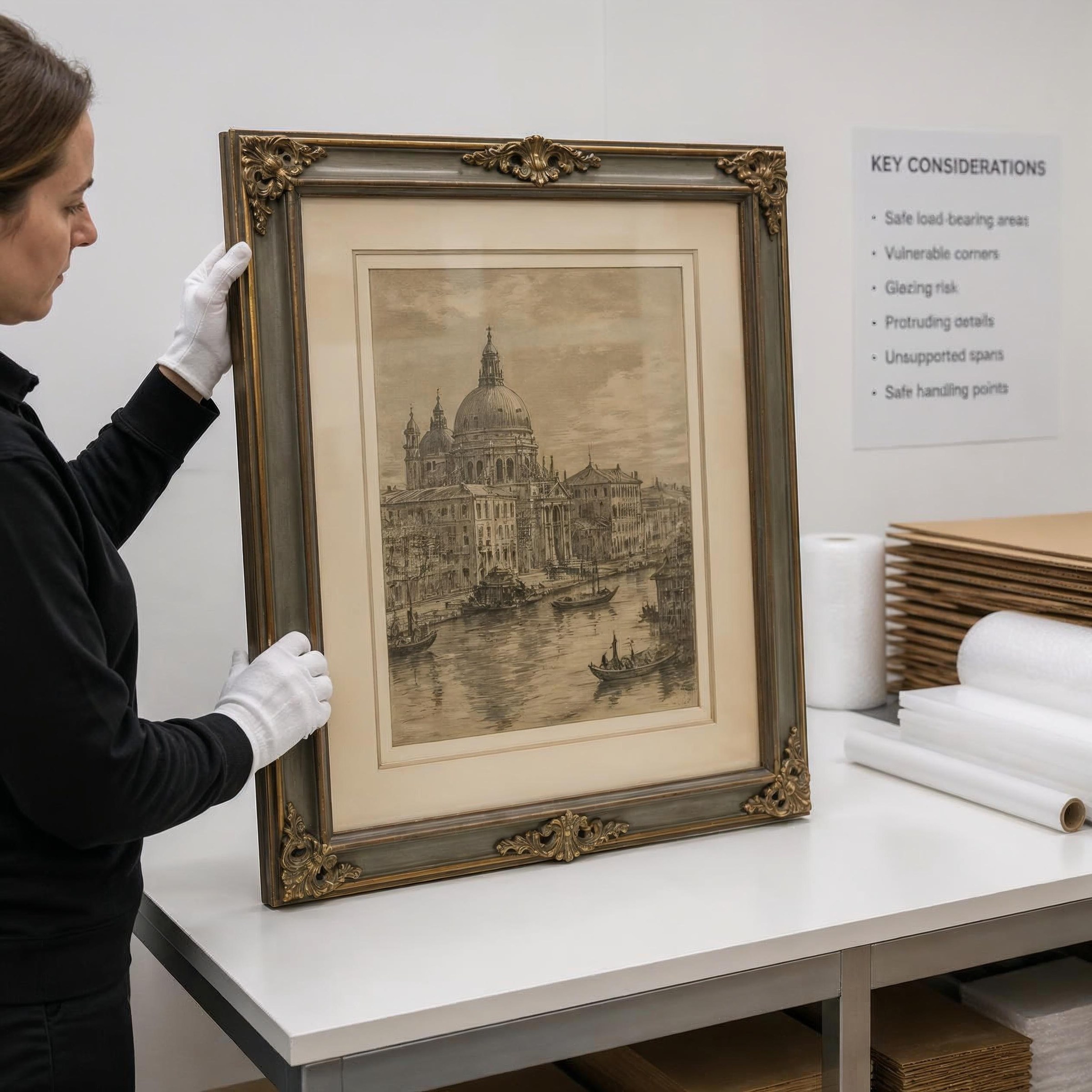
Before selecting glassine, tissue, foam, board or a crate, establish what could realistically damage the artwork. That might be abrasion, adhesion, shock, vibration, sustained compression, puncture, glazing failure, movement within the pack, moisture exposure, or an incorrect handling and unpacking sequence.
The same object can require very different packing specifications depending on the journey. A glazed framed work carried upright across London in a dedicated art vehicle has a different risk profile from the same work travelling internationally by air freight, passing through several cargo facilities and potentially being opened for inspection.
The object has not changed. The journey, handling sequence and credible failure modes have.
01
Assess where the object is strong—and where it is vulnerable
Begin with the object’s construction, not simply its size, weight and value. Record its dimensions, weight, centre of gravity, orientation requirements, and any detachable or moving elements. Identify which parts are load bearing and which are protrusions, decorative features or unsupported spans.
The aim is to understand the safe load paths through the object: where forces can be accepted and transferred without distortion or damage.
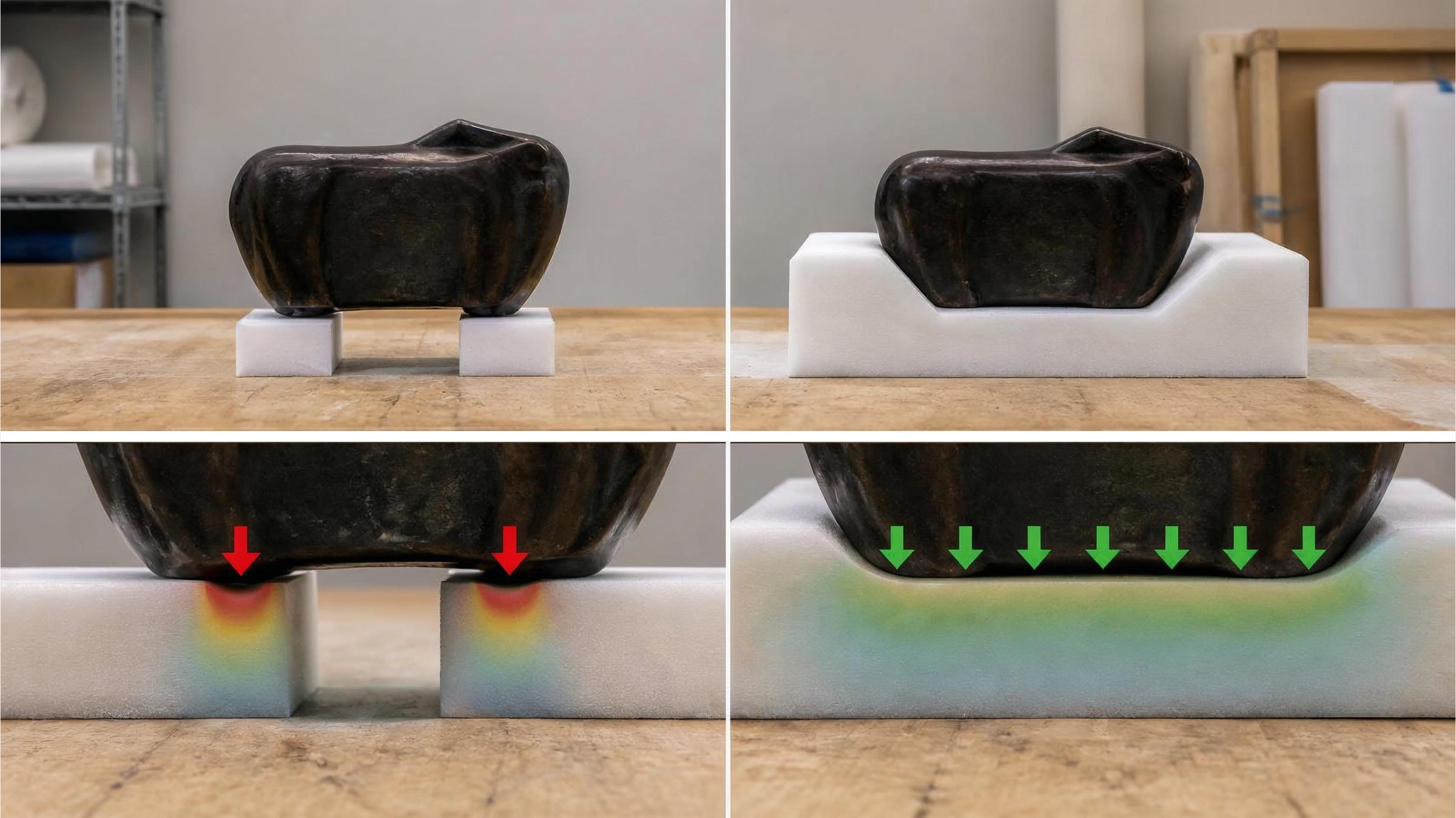
A heavy sculpture may have a robust base capable of carrying its full mass, while an extended arm or projecting element must remain completely free of restraint. Supporting both areas equally could introduce point loading at the most vulnerable feature.
Framed works require the frame, artwork and glazing to be considered separately. A strong outer frame does not automatically make the assembly safe if the glazing can flex, break or contact the artwork. Large works also need enough structural stiffness in the pack to prevent wrapping or other elements sagging across the surface.
Where the existing frame does not create sufficient clearance, a travel frame or another non-contact arrangement may be required.
Make surface-contact decisions deliberately
A material that feels soft or smooth is not automatically safe for direct contact. Acrylic paintings can remain comparatively soft and may be vulnerable to pressure, polishing, blocking and adhesion. Dirt or fingerprints may become embedded in the surface.
Gilded surfaces can be friable and vulnerable to abrasion, pressure and snagging. Contemporary mixed-media works may combine plastics, adhesives, pigments, textiles, found objects and intentionally loose components. Uncured finishes may transfer, adhere or react with a contact layer. Where material behaviour is unknown, unnecessary contact should be avoided.
A polyethylene foam pad may be appropriate beneath a sound metal base but unsuitable against a soft painted surface. The material itself is neither inherently safe nor unsafe; suitability depends on the contact location, pressure, movement, duration and material compatibility.
02
Define the complete journey and handling sequence
Distance alone is a poor measure of transport risk. Map the journey from the moment packing begins to the point at which the object is safely installed or stored.
- Dedicated art vehicle, general courier, air freight or sea freight
- Direct delivery or multiple hubs and transfers
- Number of manual handling points and the experience of each team
- Mechanical handling and palletisation
- Likely orientation changes
- Customs or security inspection
- Short-term or extended storage
- Temperature and humidity changes
- Duration of vibration exposure
- Stacking and compression risks
- Whether the package will be reused for a return journey
- Who will unpack the object, and under what conditions
A direct movement by a trained art-handling team may allow a pack with clearly labelled removable restraints and a controlled opening sequence. The same arrangement may be too dependent on specialist knowledge if it is opened by airport security, a general receiving team or an unknown third party.
Test the handling sequence
- Can the pack be lifted without gripping vulnerable areas?
- Is the correct orientation immediately obvious?
- Can a lid or panel be removed without tools passing close to the artwork?
- Could restraints be removed in the wrong order?
- Can the object be inspected and repacked safely?
Journey complexity also changes the crate-versus-carton threshold. A correctly specified multiwall carton may be appropriate for a controlled local movement. Repeated transfers, stacking, puncture risk, mechanical handling or uncontrolled freight environments may justify a rigid crate or engineered outer case.
A crate is not automatically safer. Poorly positioned battens, insufficient stiffness, exposed fasteners or badly designed restraints may simply transfer greater forces into the object.
03
Identify the failure modes the pack must control
Once the object and journey are understood, define the credible failure modes. They should be specific enough to guide decisions about which materials should be used.
Glazed framed painting
- Abrasion or pressure against a decorated frame
- Glazing breakage and shard contact
- Corner impact
- Vibration loosening frame components
- Board deflection onto the glazing
- Moisture, orientation or unpacking errors
Heavy mixed-media sculpture
- Point loading beneath an uneven base
- Unsupported projections
- Movement within the pack or crate
- Restraint straps damaging the finish
- Vibration loosening assembled elements
- Instability from a high centre of gravity
This stage prevents over-packing as well as under-packing. More layers are not useful when they do not control a defined risk. Additional wrapping can create pressure, trap contamination, obscure handling points or make unpacking more dangerous.
The pack should instead be designed as a system in which every material has a stated function.
04
Match cushioning to static load, shock and vibration
Cushioning selection is not simply a choice between hard and soft foam. Consider the object’s size and weight, the bearing area supported by the foam, anticipated shock risk, available cushioning travel, journey duration, and how the complete object-and-cushion system may respond to vibration.
Static versus dynamic loading
Static loading is the continuous pressure exerted while the object rests on cushioning. A small contact area creates a higher static load than a broad support, even where the object’s overall weight is unchanged.
Dynamic loading occurs during drops, impacts, sudden braking and handling shocks. Effective cushioning reduces peak acceleration by allowing the object to decelerate over a controlled distance. Too little thickness may cause the foam to bottom out; too much unsuitable foam may leave the object poorly restrained or create an undesirable vibration response.
Compression set
Compression set is the permanent deformation or loss of recovery that may occur after foam remains under load. If cushioning settles during storage or a long journey, a previously close-fitting cavity can develop looseness, allowing movement during later handling events. Temperature, load duration and degree of compression all affect this behaviour.
Foam density and firmness
Density alone does not determine cushioning performance. Firmness, cell structure, thickness, bearing area, compression characteristics and expected loading must also be considered.
Ethafoam is commonly used for firm support, fabricated blocks, edge protection and load spreading. Plastazote is a closed-cell polyethylene foam available in a range of grades and can be accurately fabricated into supports, liners and cavities. Softer polyurethane foams can reduce local contact pressure around lighter or delicate components, but may be unsuitable where they compress excessively, bottom out, creep or permit uncontrolled movement.
A heavy sculpture resting on a thin sheet of soft foam may compress it until almost no protective travel remains. A firmer support spread across a larger safe load-bearing area may perform better, possibly combined with a softer intermediate layer where contact pressure needs to be reduced.
Resonance and vibration
A cushion system has its own natural frequency. If transport vibration occurs near that frequency, resonance can increase movement rather than reduce it. Cushioning can isolate, transmit or amplify different frequencies. The objective is to control movement without repeated oscillation, collision, bottoming out or contact with the outer case.
Where an object is exceptionally fragile, unusually massive or particularly sensitive to vibration, specialist cushion design, testing or engineering input may be required.
05
Build a complete material system
The final packing specification will normally combine materials with four distinct functions.
Surface separation
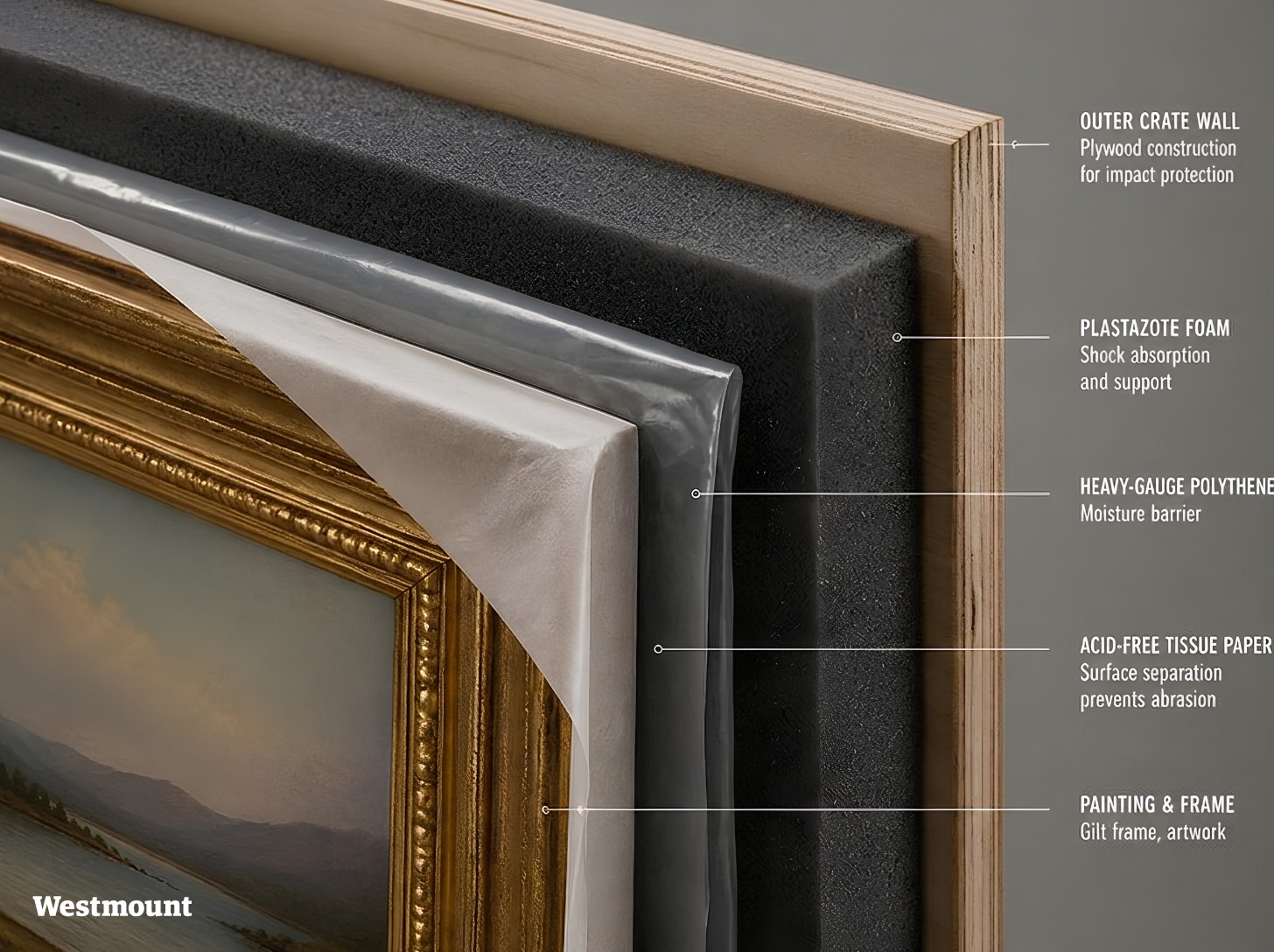
Acid-free tissue or glassine, non-woven materials such as Tyvek, barrier films, or supported clearance where direct contact is unacceptable.
Cushioning and restraint
Polylam or Ethafoam, Plastazote, softer polyurethane foams, profiles, blocks, cavity liners, padded restraints or engineered suspension systems.
Structural protection
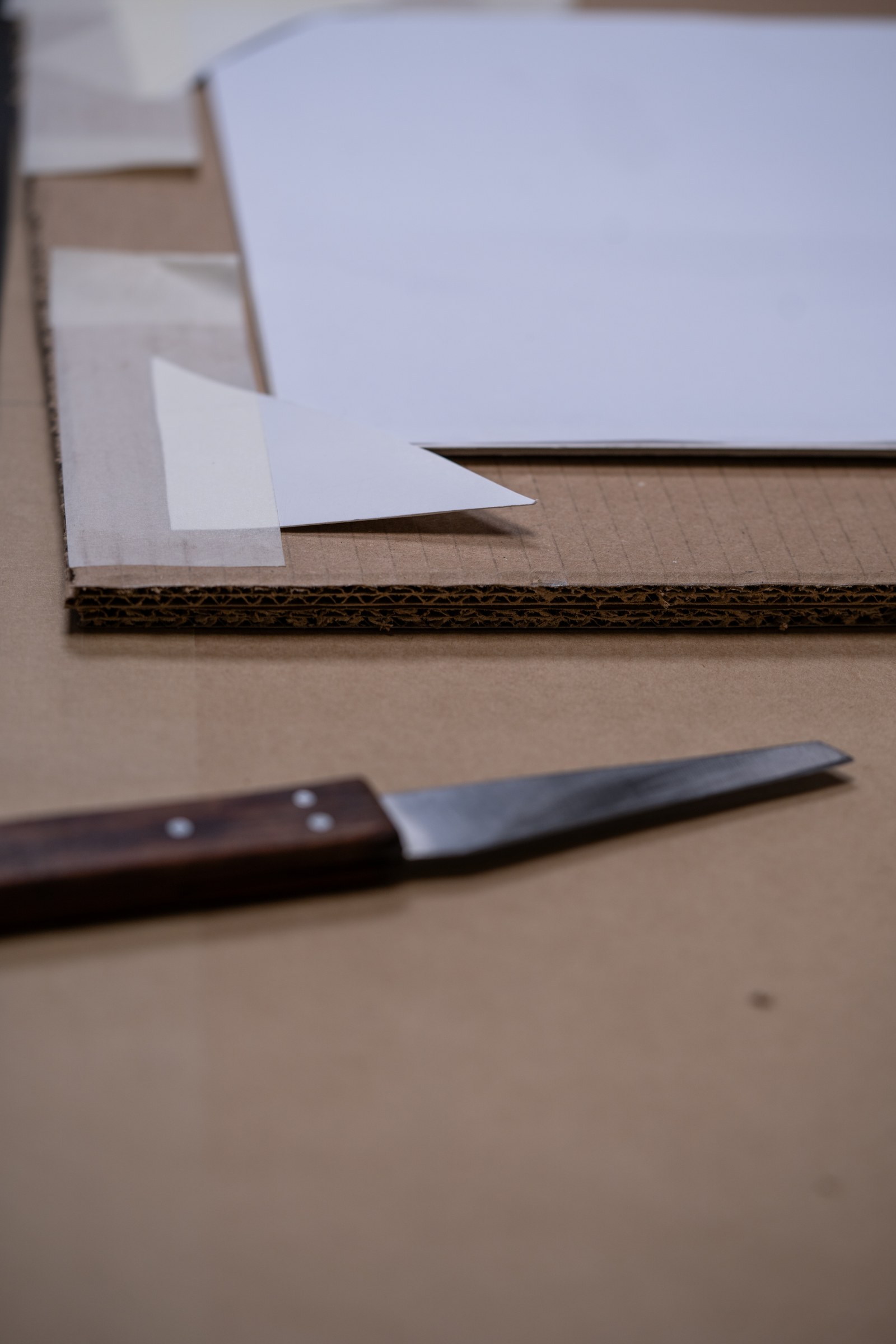
Double- or triple-wall corrugated board, honeycomb board, rigid sheet materials, timber framing and crates.
Environment and contamination
Sealed liners, barrier films, dust and moisture protection, insulation, and properly calculated desiccants within an appropriate enclosure.
Filling empty space is not the same as engineered cushioning. Loose void fill may prevent obvious movement but gives limited control over load distribution, migration or creep, impact response, and repeated vibration. The object should be restrained sufficiently to prevent harmful movement without placing excessive pressure on vulnerable surfaces or structural elements.
The outer structure should resist compression, puncture and handling loads without creating unsupported spans that could flex into an artwork. Loads created by stacking, lifting, strapping and tie-downs should travel through the outer structure rather than through fragile parts of the object.
Wrapping may buffer short-term environmental change, but it should not automatically be described as climate control. Large temperature changes can still create condensation risks, particularly where moisture is trapped within a sealed system or released from the artwork after packing.
A glazed framed work might therefore require non-contact surface clearance, cushioned corner and edge support, a controlled cavity, a stiff outer carton or crate, moisture protection and clearly marked opening instructions. Each element controls a different failure mode.
06
Validate the pack before approving it
Before the specification is signed off, test the logic of the complete system.
- 01What are the most likely points of failure?
- 02Which surfaces must not be touched?
- 03Where can the object safely bear its own weight?
- 04Have point loading and unsupported spans been eliminated?
- 05Can the cushioning carry the static load without excessive compression?
- 06Is there sufficient cushioning travel for possible movement and impact?
- 07Could the cushion-and-object system resonate or allow repeated movement?
- 08Is the cavity correctly sized and restrained?
- 09Does the outer structure meet the crate-versus-carton threshold?
- 10Can handlers lift, open, inspect and repack the object safely?
- 11Are all materials compatible with the object and expected journey duration?
Professional fine art packing ultimately depends on judgement, experience and a clear understanding of the object and journey. Westmount’s role is to understand how professional packers think, and to curate and specify high-performance materials that provide the right levels of risk control.
Where the correct grade, format or performance characteristic is uncertain, the material conversation should begin with the object, the failure mode and the journey—not simply with a product name.