
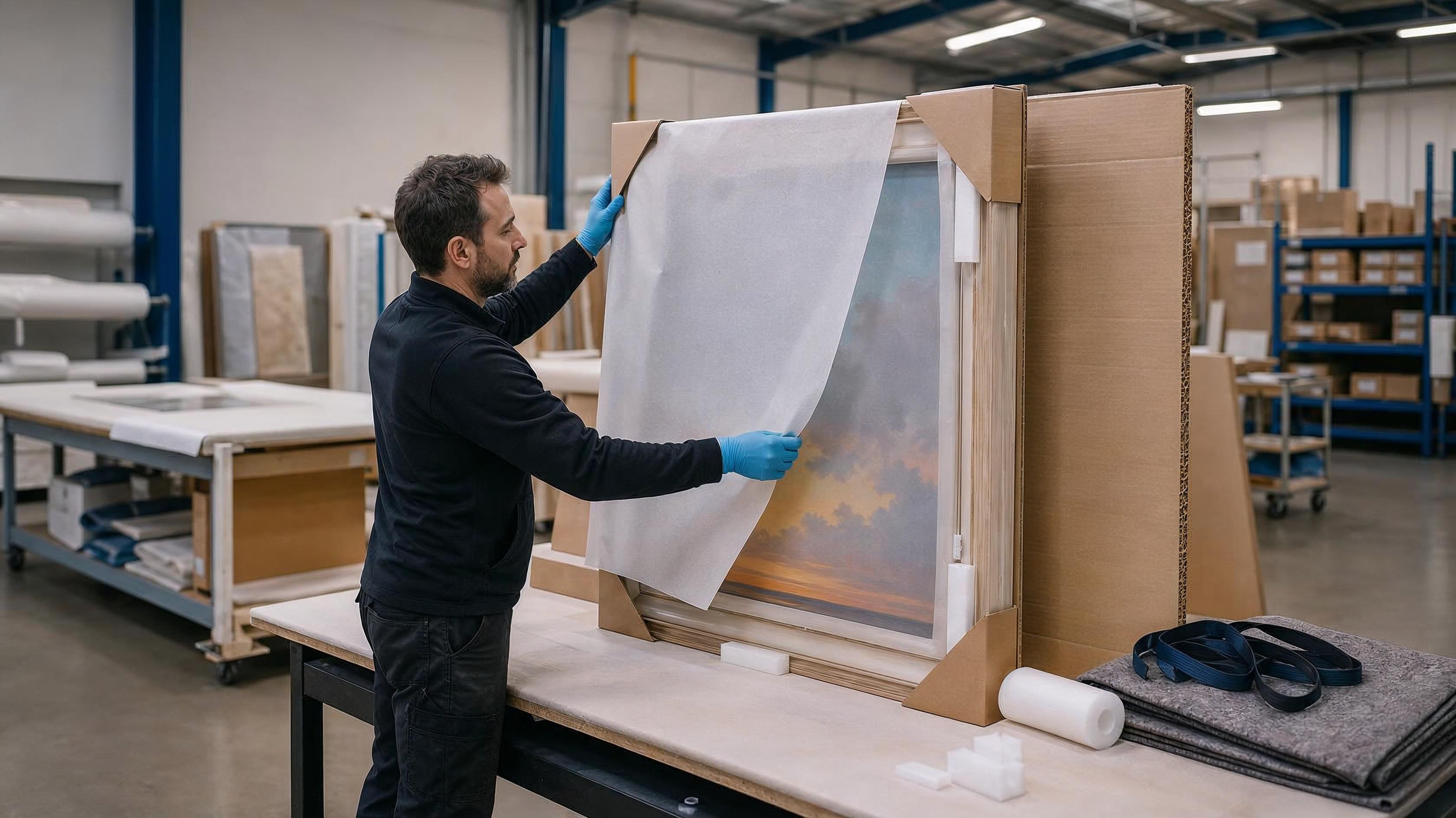
Every packaging material has an environmental impact. The objective is to reduce the overall impact of the packing system without transferring additional risk to the artwork.
An inadequately protected object may require conservation, repacking and additional transport—all of which would vastly outweigh the benefit gained from using less packaging.
01
Start with the object and journey
Before selecting materials, assess the complete risk profile.
- The object’s construction, condition and surface sensitivity
- Its weight, dimensions and vulnerable areas
- The number and type of handling points
- Journey length and transport method
- Exposure to vibration, shock, moisture or temperature changes
- The duration of packing and any subsequent storage
- Whether the pack and its materials can realistically be recovered and reused
A material suitable for a robust framed print on a controlled UK shuttle may be unsuitable for a friable painting travelling internationally. Short-term transit packing and long-term storage also impose different requirements.
Suitability depends not only on a material’s stability, but on how it is used, whether it contacts the object and for how long. Strength, flexibility, abrasiveness and load-bearing capacity must all be considered.
02
Apply a risk-controlled packaging hierarchy
Reduction and reuse should come before material substitution. A durable synthetic component used repeatedly may have a lower overall impact than a renewable product discarded after one journey.
- 01Eliminate packaging that performs no necessary function.
- 02Reduce material quantities without reducing protection.
- 03Reuse existing packs and components.
- 04Substitute lower-impact materials where performance is suitable.
- 05Design the pack for separation, recovery and recycling.
- 06Use a realistic end-of-life route.
03
Use paper and fibre according to their strengths
Paper and fibre products can replace or reduce synthetic packaging in many applications, but each performs a different function.
Acid-free tissue can provide lightweight wrapping, interleaving and dust protection. Glassine offers a smooth, relatively non-abrasive surface for suitable objects. Neither is a substitute for impact protection, and any direct-contact material must be selected for the particular surface.
When correctly formed into a scrunched paper pad, high-quality machine-finished (MF) tissue can provide cushioning for some glass and porcelain objects with detailed shapes and protrusions. Glassine requires caution around photographs, tacky or insufficiently cured finishes and high humidity, where it may adhere.
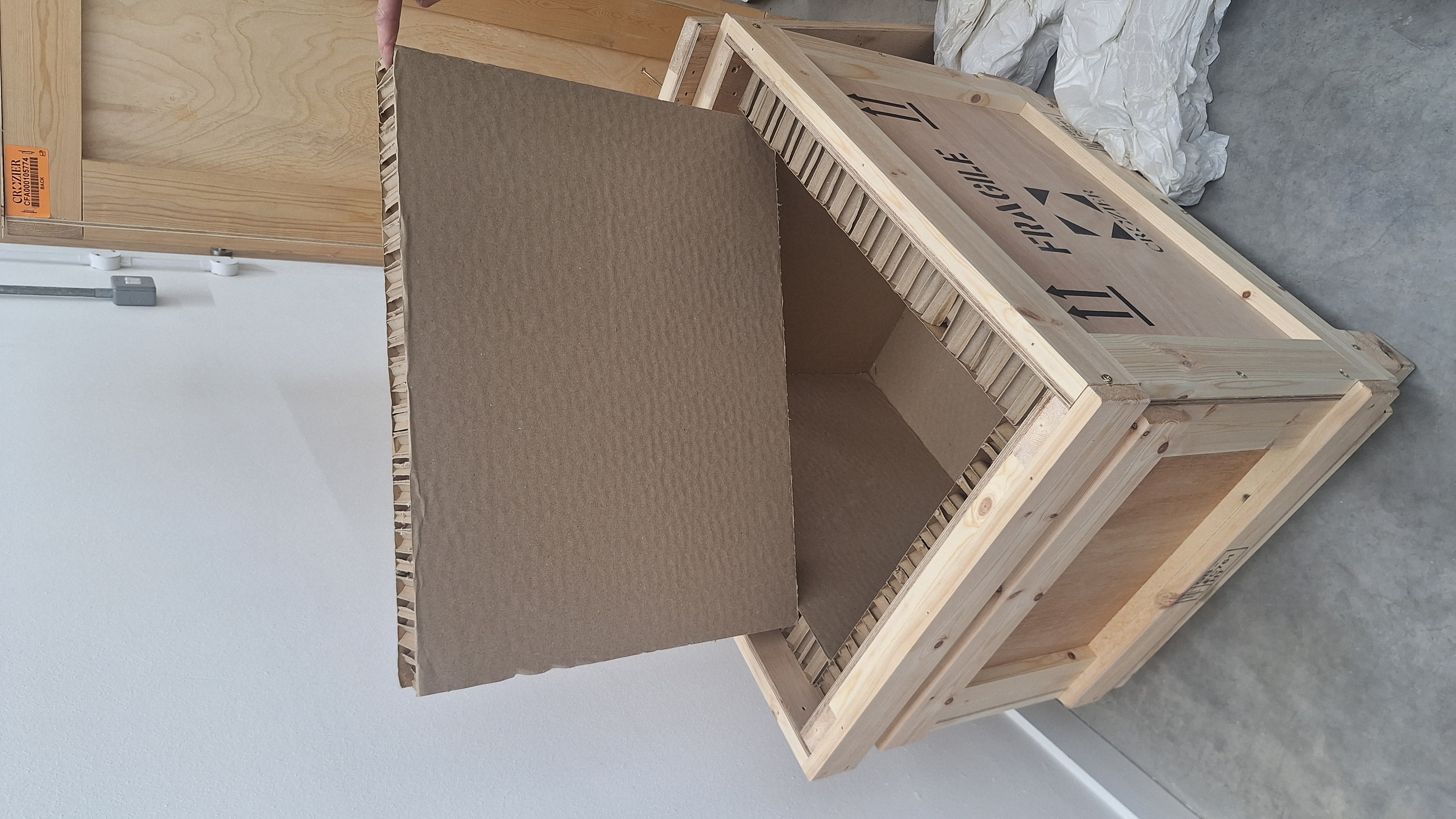
Cardboard sheets work for layering, separation, puncture protection and sleeves or softpacks. Corrugated board adds structural protection, while honeycomb board provides high rigidity at relatively low weight for panels, spacers, partitions and lightweight outer structures.
Commercial cardboard can be acidic, and absorbed moisture reduces the rigidity and compression strength of fibre products. Extra-rigid board such as Super 900 can provide resilient surface and impact protection and may be reused if kept clean, dry and removed without destructive cutting.
04
Reuse before replacement
Reusable packaging can produce substantial material savings, particularly on regular routes or where return logistics are already established.
- Transit blankets and reusable covers
- Frame and corner protectors
- Returnable art pouches
- Adaptable crates, cases and T-frames
- Reusable straps, buckles and mechanical restraints
- Clean foam, board and wrapping materials recovered from previous packs
Successful reuse requires more than retaining materials after unpacking. Components must be inspected for contamination, crushing, tears, loss of resilience and exposed fixings. Clear ownership and return arrangements are also necessary.
Design packs for non-destructive opening wherever possible. If a reusable cover must be cut away, or foam is covered with aggressive tape so it cannot be recovered, its theoretical reusability has little practical value.
05
Reduce cushioning without reducing performance
Cushioning is one area where careless substitution creates the greatest risk. It must control transmitted shock and vibration while supporting the object without excessive deflection or permanent compression.
Honeycomb structures, folded cardboard and paper cushioning can work well for robust objects, void filling, separation and load distribution. Limitations include moisture sensitivity, lower recovery after repeated impacts and the possibility of abrasion, dust or concentrated loading.
Where resilient cushioning is required, the better answer may be to use less of a proven foam rather than eliminate it. Self-adhesive strips can be placed at calculated contact or spacing points instead of lining an entire pack; removable pads can be recovered and reused.
Recycled foam profiles can reduce virgin material use where their cushioning characteristics suit the load and journey. Recycled content alone is not enough: resilience, compression set, surface compatibility and service life still need verification.
Take extra care with long-term storage
Recycled polyethylene foam may already contain degraded material. Emerging plant-based products can be useful in controlled, short-term applications, but long-term storage claims should be supported by technical evidence and conservation guidance.
06
Use tapes and closures selectively
Paper tape can complement fibre-based packs and reduce mixed-material contamination. Reusable straps, buckles and mechanical closures may be better where packs are opened and closed repeatedly.
Specialist synthetic tape may still be necessary where strength, moisture resistance or adhesion is critical. Apply only what is required and avoid covering reusable material unnecessarily.
Water-activated paper tape is generally impractical for fine art packing because it often requires a bench-mounted dispenser and introduces water into the packing environment.
07
Judge the complete pack
A material should never be chosen solely because it is described as recycled, recyclable or plastic-free. The correct decision depends on the object, protective function, journey, duration of use, reuse opportunity and actual recovery route.
Reusable corners, blankets and straps, with cardboard or Super 900 sheets for rigid protection.
Tissue or glassine, cardboard sheets and paper tape.
Shaped fibre-board supports with recycled foam profiles only at vulnerable contact points.
08
A practical route to more sustainable art packing
Begin by auditing high-volume materials and identifying where waste arises. Prioritise easy reductions such as better-sized packs, selective cushioning and reusable components. Trial substitutions on controlled, lower-risk shipments and record material consumption and packing performance.
Ask suppliers for composition, recycled-content evidence, technical data and end-of-life guidance. Standardise successful pack designs, train packing teams to recover materials without damage, and agree return arrangements with customers and transport partners.